Old Images of Renfrew, Scotland

 Glimpse history through old images of Renfrew, the county town in the west central lowlands of Renfrewshire, Scotland.

Renfrew Tolbooth

The original Renfrew Toolbooth was built in 1670.

Repairs had to be carried out in 1688, at the expense of the Convention of Royal Burghs, as the building had fallen into ruinous decay. With an added new wing, the renovated building served as a Town Hall, as well as being a jail, keeper's home, and court.

According to 1887 publication "The castellated and domestic architecture of Scotland, from the twelfth to the eighteenth century", by David MacGibbon and Thomas Ross, the Tollbooth followed the convention for an outside staircase leading up to a first floor doorway.

There was a tower, possibly a bell tower, as well as a council chamber.

Court proceedings were carried out there until 1748, though the jail remained open until 1839.

The new Town Hall was built in 1871, replacing the ancient Tollbooth.

The key to the original Renfrew Tolbooth is now held in the Glasgow Art Galleries and Museum.
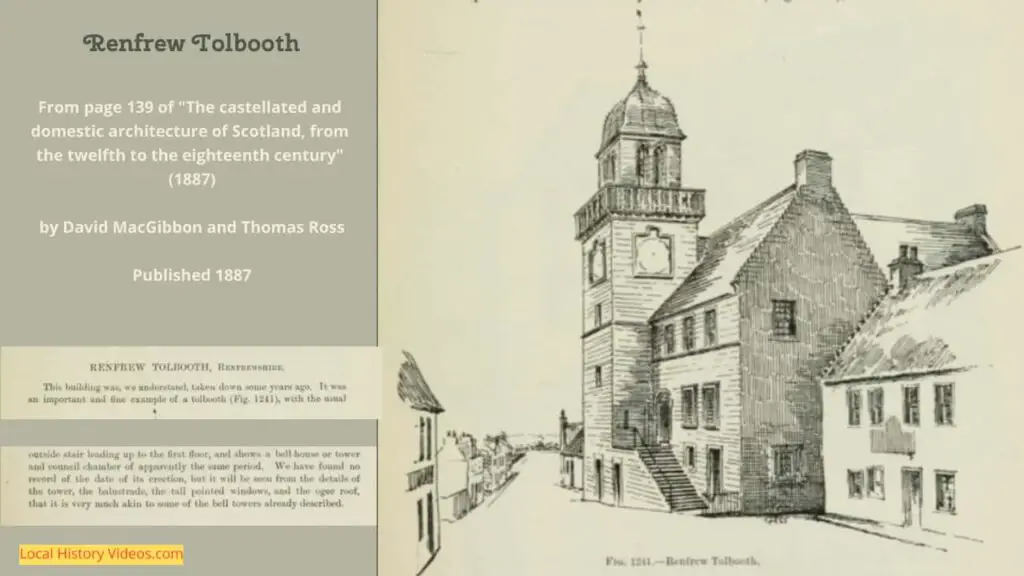
Renfrew Tolbooth
An illustration of Renfrew Tolbooth, shown on page 139 of "The castellated and domestic architecture of Scotland, from the twelfth to the eighteenth century". By the time the book was published in 1887, the Tolbooth was long gone.

Old Photographs of Renfrew

Enjoy a video showcase of old photographs of this historic town.


Old Photographs Renfrew Renfrewshire Scotland: tourscotland (YouTube) 
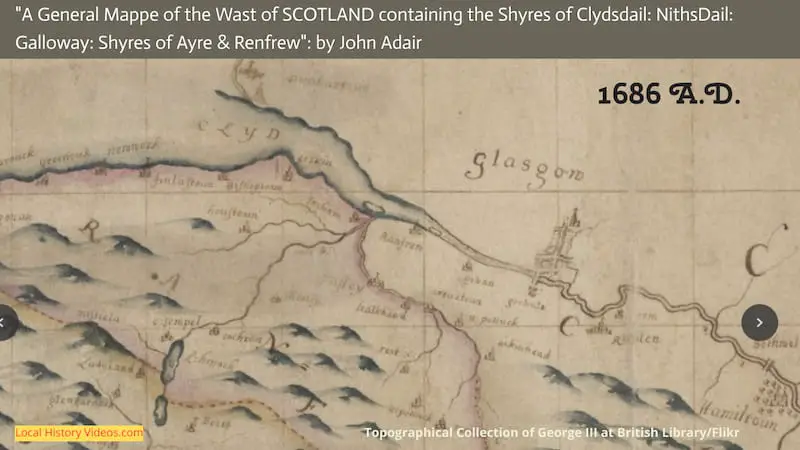

Map of Western Scotland 1686
"A General Mappe of the Wast of SCOTLAND containing the Shyres of Clydsdail: NithsDail: Galloway: Shyres of Ayre & Renfrew": by John Adair, published in 1686

Brief History of Renfrew

Renfrew got its name from the ancient term rhyn frwd, meaning 'point at the current', referring to the point where the River Cart enters the River Clyde.

In the 12th Century, King David I gave Walter fitz Alan the hereditary appointment as High Steward of Scotland. The title came with the lands of Mearns, Strathgryfe, North Kyle, and Renfrew, making Renfrew's first known documented reference.

Walter fitz Alan built the first Renfrew Castle, at a site now occupied by the Braehead shopping centre. Its aim was to both protect western Scotland from Norse invaders, and prevent Somerled, the Norse-Gaelic Lord of the Isles, expanding his territory.

King Malcolm IV, the grandson of King David I, demanded fealty, or formal acknowldgement of submission and loyalty, from Somerled. In response, Somerled and his warriors sailed to the mainland, where they were joined by other rebellious war leaders.

The two armies met for the Battle of Renfrew in 1164. King Malcolm IV's army was victorious, and Somerled was killed.

In the 14th Century, King Robert III created a Royal Burgh, making Renfrew the only town in the area permitted to hold markets and fairs.

The Monmouth Rebellion, attempting to overthrow King James II, took place in 1685. Archibald Campbell, the 9th Earl of Argyll, took part. He was tracked down to Renfrew, where he was injured and captured, at a site marked by the Argyle Stones. After being taken to Edinburgh, the Earl was executed there.

By 1775, the ruinous Renfrew Castle had almost disappeared, though the surrounding ditch was still present.

In the 18th Century, a soap works was built in what is now Castlehill Gardens, using stone from the castle ruins.

On 13 March 1941, German World War II bombers dropped bombs and incendiary devices on St James Roman Catholic Church in Renfrew. Three Polish airmen in their twenties - Lance Corporal Pawel Radke, Aircraftman Antoni Ptaszkowski, and Aircraftman Zygmunt Sokolowski - died in their brave endevours to save the church from fire.

The heir to the British throne still holds the courtesy title Baron of Renfrew.


People of Renfrew

The list of notable people from Renfrew includes:

  • Derek Mackay, Former SNP politician
  • Lorne Crerar, Lawyer
  • James McDonald, WW1 Flying Ace
  • Alex Hunter, Footballer
  • Bob Harley, Footballer
  • Winifred Drinkwater, Aviator
  • Jackie Husband, Footballer

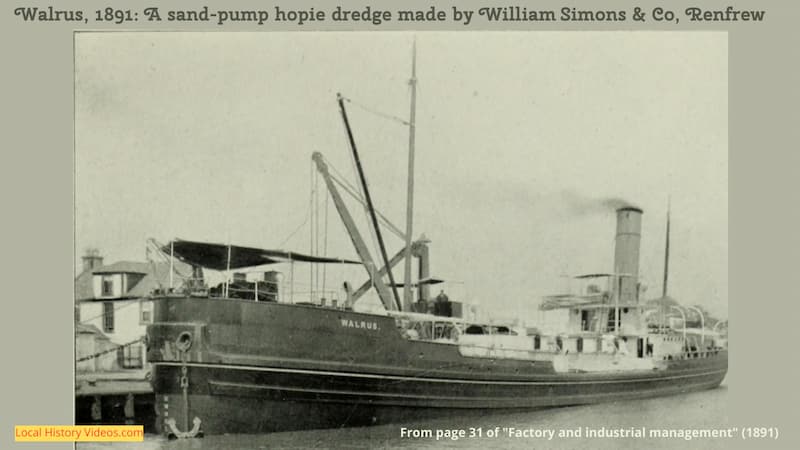
Walrus 1891 made in Renfrew
The sand-pump hopie dredge called the Walrus was made by William Simons & Co in Renfrew. A photograph of the Walrus was shown on page 31 of "Factory and Industrial Management", published in 1891.

Renfrew Facebook Groups

Enjoy finding out more about the history of the town through the Facebook group OLD Renfrew - Know & love your town.

Comments

Popular posts from this blog

Old Images of Spokane, Washington: Vintage Photos and Archive Film

Glimpse history through old images of  Spokane , Washington. Spokane  in 1902 Panorama of Spokane, Washington, taken sometime around 1902. With thanks to the Library of Congress Prints and Photographs Division. Closeup of two extracts from the panorama of Spokane, Washington, taken sometime around 1902. With thanks to the Library of Congress Prints and Photographs Division. Closeup of two extracts from the panorama of  Spokane , Washington, taken sometime around 1902. With thanks to the Library of Congress Prints and Photographs Division. Spokane ’s Davenport Restaurant Spokane ’s Davenport Restaurant was an internationally renowned venue which offered popular Sunday afternoon tea dances. Old photo of the Davenport Restaurant in Spokane, Washington, taken around 1908. With thanks to the Library of Congress Prints and Photographs Division. Closeup of an extract of the old photo of the Davenport Restaurant in  Spokane , Washington, taken around 1908. With thanks to the...

The History of Manchester, New Hampshire and the Amoskeag Manufacturing Company

  The story of Manchester, New Hampshire, is the definitive narrative of the American Industrial Revolution. It is a chronicle that spans centuries, transforming a vital Indigenous fishing ground into a planned corporate utopia that housed the world's largest textile empire, before navigating a devastating collapse and emerging as a modern high-tech hub. At the absolute center of this transformation was the Merrimack River, the Amoskeag Falls, and a corporate behemoth known as the Amoskeag Manufacturing Company. Manchester, New Hampshire, composed from sketches taken near Rock Raymond by J.B. Bachelder, 1855. 1. Ancient Waters and Colonial Beginnings (Pre-1810) Long before brick mills lined the Merrimack River, the geography of modern-day Manchester was shaped by the Amoskeag Falls . Dropping approximately 55 feet over a short distance, the roaring rapids created a massive natural barrier for migrating fish—and an invaluable resource for human inhabitants. Walking along the street ...

10 Historical Facts That Shaped North Conway, New Hampshire

  Nestled dramatically beneath the sheer granite cliffs of Cathedral Ledge in Carroll County, North Conway, New Hampshire , is famous as a premier gateway to the White Mountains. Unlike a standalone municipality, North Conway is a distinct major village legally contained within the broader township of Conway. Its evolution from a fertile Abenaki riverfront valley into a haven for 19th-century fine artists and a pioneer of American winter sports represents one of the most successful resort transitions in New England. Old photo of the skimobile up Cranmore Mountain, North Conway, NH - circa 1940   Part of the Original 1765 Royal Charter: North Conway’s municipal history began on October 1, 1765 , when colonial Governor Benning Wentworth issued a formal royal charter establishing the township of Conway. Named directly to honor Henry Seymour Conway—a prominent British statesman and military commander who championed colonial interests in Parliament—the grant required early pioneer...