Old Images of Scone, Perth & Kinross

 Enjoy a glimpse of history through old images of Scone, in Perth & Kinross, Scotland.


Scone Palace

Historians and publishers were long ago attracted to images of Scone Palace, the place where Macbeth, Robert the Bruce and King Charles II were crowned.

As you can see from these images, the 19th century public enjoyed Gothic and romantic portrayals of what had originally been an Augustinian priory.
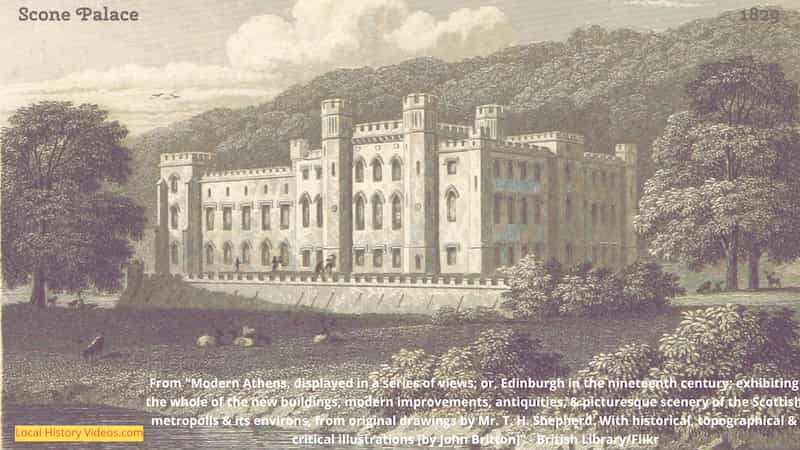
Old picture of Scone Palace in 1829
Old picture of Scone Palace, from From "Modern Athens, displayed in a series of views; or, Edinburgh in the nineteenth century; exhibiting the whole of the new buildings, modern improvements, antiquities, & picturesque scenery of the Scottish metropolis & its environs, from original drawings by Mr. T. H. Shepherd. With historical, topographical & critical illustrations [by John Britton]", published in 1829 - British Library/Flikr
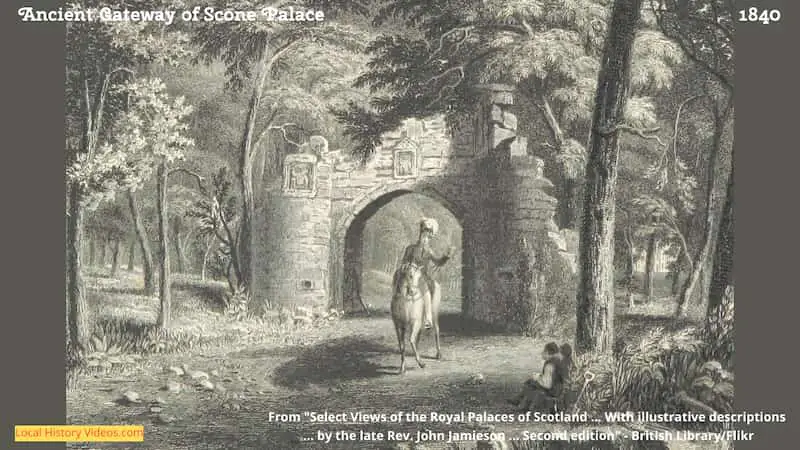
old picture of the Scone Palace Ancient Gateway
Old picture of the ancient gateway at Scone Palace, from "Select Views of the Royal Palaces of Scotland", published in 1840 - British Library/Flikr
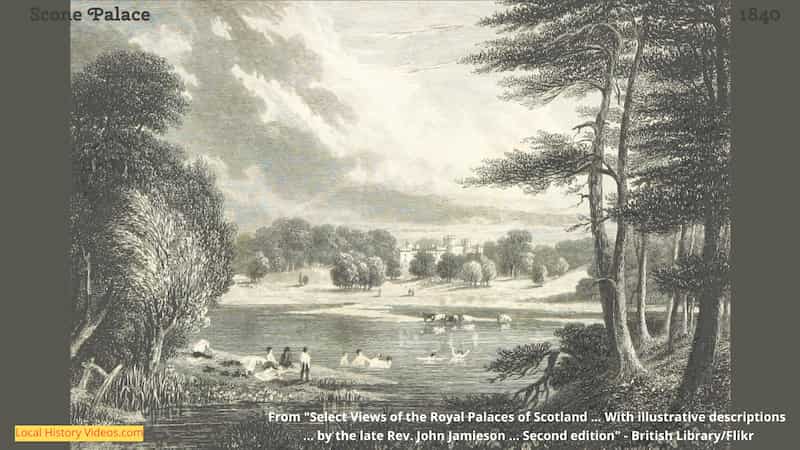
Old picture of Scone Palace 1840
Old picture of Scone Palace, from "Select Views of the Royal Palaces of Scotland" published in 1840 - British Library/Flikr
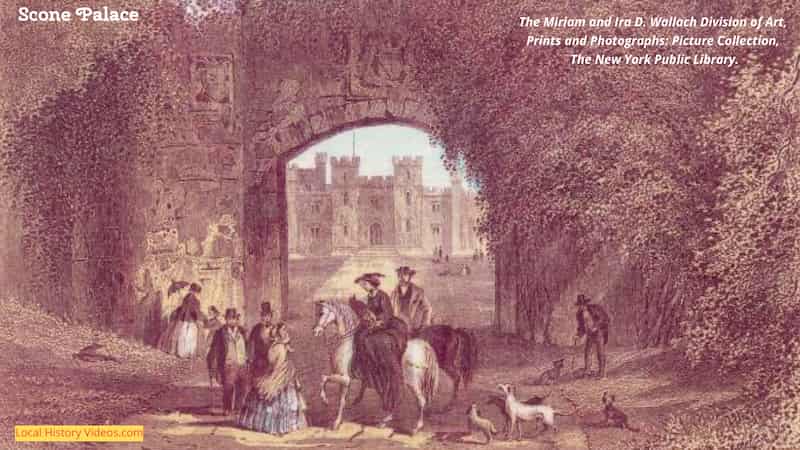
Old Painting of Scone Palace Scotland
Old Painting of Scone Palace, from the Miriam and Ira D. Wallach Division of Art, Prints and Photographs: Picture Collection, the New York Public Library.

Old Scone Mercat Cross

The Old Scone Mercat Cross, which is also called the Old Scone Market Cross, was erected in the Middle Ages. It stood in the market place of Scone village, which grew up around the monastery and royal residence.

The cross still exists today, and is a Category A listed structure. It has an octagonal shaft, topped with a moulded capital and foliated cross.

However, the cross now stands in the grounds of Scone Palace, a few yards south of its traditional location.

The old village in which it once stood was demolished in 1803 and 1804, with the new village nearby taking on the name of Scone village.
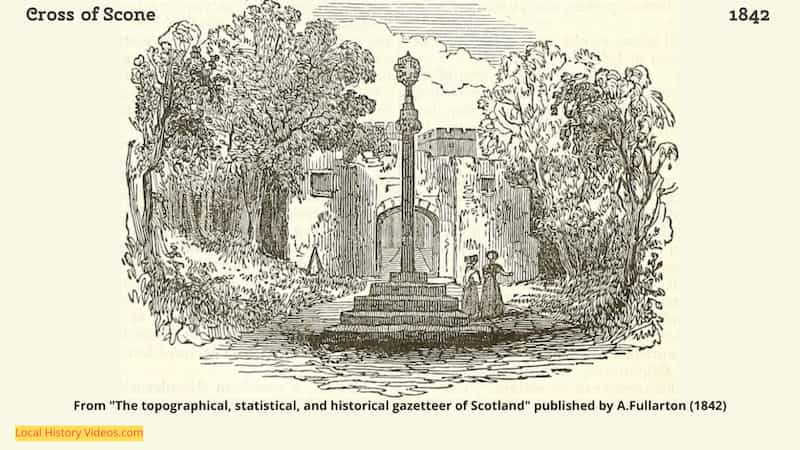
Cross of Scone 1842
Old image of the Cross of Scone, from "The topographical, statistical, and historical gazetteer of Scotland", published by A. Fullarton in 1842

Queen Victoria's Visit

A book called "Memorial of the Royal Progress in Scotland" was published in 1843, charting the royal tour of Scotland by Queen Victoria and Prince Albert.

Several pages were dedicated to their activities in the area during their stay at Scone Palace.
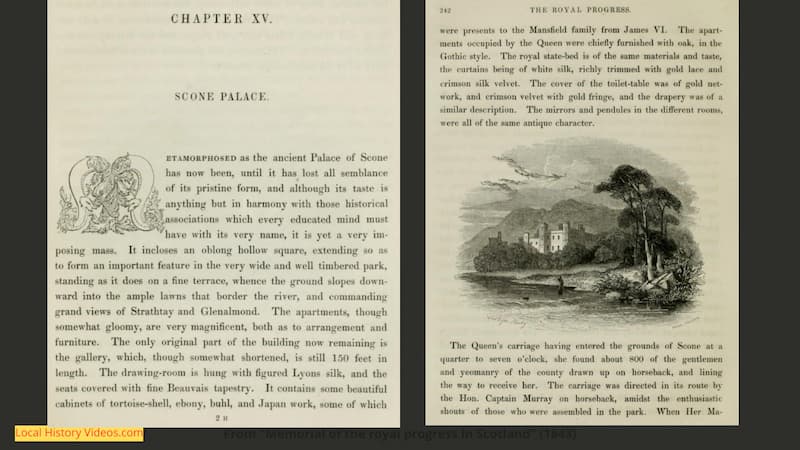
Old book chapter about Queen Victoria's stay at Scone Palace
Pages 241 and 242 of "Memorial of the royal progress in Scotland", published in 1843, covering the activities of Queen Victoria and Prince Albert during their stay at Scone Palace
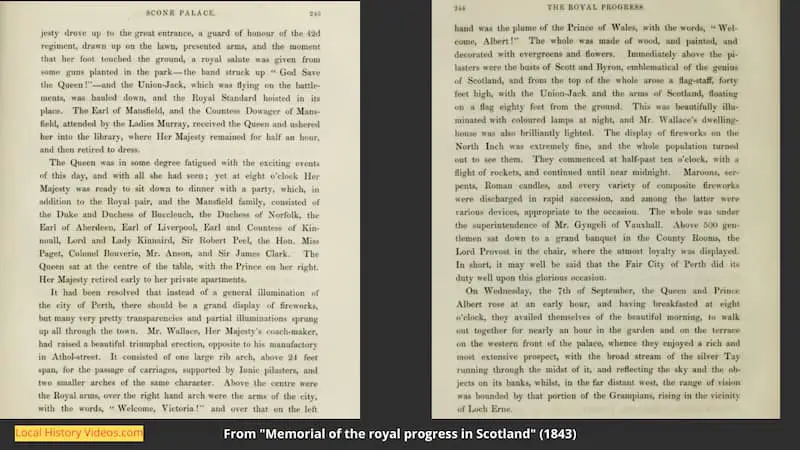
Old book chapter about Queen Victoria's stay at Scone Palace
Pages 243 and 244 of "Memorial of the royal progress in Scotland", published in 1843, covering the activities of Queen Victoria and Prince Albert during their stay at Scone Palace
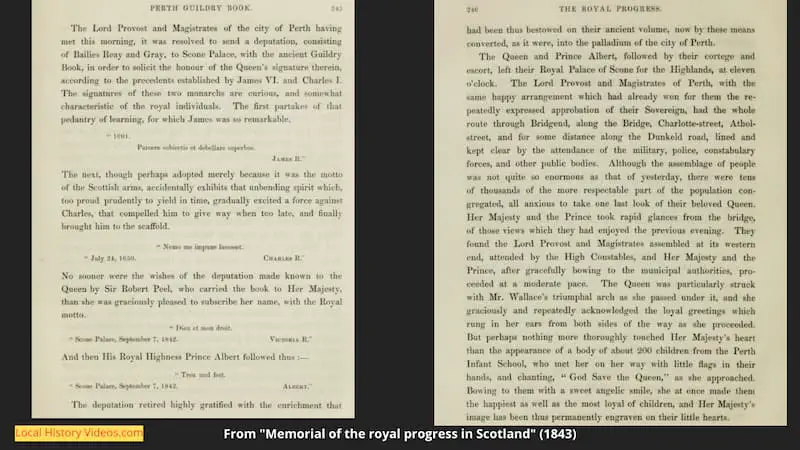
Old book chapter about Queen Victoria's stay at Scone Palace
Pages 245 and 246 of "Memorial of the royal progress in Scotland", published in 1843, covering the activities of Queen Victoria and Prince Albert during their stay at Scone Palace

Old Photos of Scone, Scotland

In the early 19th century, the old village was demolished, when David William Murray, 3rd Earl of Mansfield commissioned an extension of the palace.

Villagers were moved to a newly constructed village nearby, also called Scone village.

Enjoy a video showcasing some of the old photos taken of the village's people and places.


Old Photographs Of Scone Village Perthshire Scotland: tourscotland (YouTube)


Comments

Popular posts from this blog

Old Images of Spokane, Washington: Vintage Photos and Archive Film

Glimpse history through old images of  Spokane , Washington. Spokane  in 1902 Panorama of Spokane, Washington, taken sometime around 1902. With thanks to the Library of Congress Prints and Photographs Division. Closeup of two extracts from the panorama of Spokane, Washington, taken sometime around 1902. With thanks to the Library of Congress Prints and Photographs Division. Closeup of two extracts from the panorama of  Spokane , Washington, taken sometime around 1902. With thanks to the Library of Congress Prints and Photographs Division. Spokane ’s Davenport Restaurant Spokane ’s Davenport Restaurant was an internationally renowned venue which offered popular Sunday afternoon tea dances. Old photo of the Davenport Restaurant in Spokane, Washington, taken around 1908. With thanks to the Library of Congress Prints and Photographs Division. Closeup of an extract of the old photo of the Davenport Restaurant in  Spokane , Washington, taken around 1908. With thanks to the...

The History of Manchester, New Hampshire and the Amoskeag Manufacturing Company

  The story of Manchester, New Hampshire, is the definitive narrative of the American Industrial Revolution. It is a chronicle that spans centuries, transforming a vital Indigenous fishing ground into a planned corporate utopia that housed the world's largest textile empire, before navigating a devastating collapse and emerging as a modern high-tech hub. At the absolute center of this transformation was the Merrimack River, the Amoskeag Falls, and a corporate behemoth known as the Amoskeag Manufacturing Company. Manchester, New Hampshire, composed from sketches taken near Rock Raymond by J.B. Bachelder, 1855. 1. Ancient Waters and Colonial Beginnings (Pre-1810) Long before brick mills lined the Merrimack River, the geography of modern-day Manchester was shaped by the Amoskeag Falls . Dropping approximately 55 feet over a short distance, the roaring rapids created a massive natural barrier for migrating fish—and an invaluable resource for human inhabitants. Walking along the street ...

10 Historical Facts That Shaped North Conway, New Hampshire

  Nestled dramatically beneath the sheer granite cliffs of Cathedral Ledge in Carroll County, North Conway, New Hampshire , is famous as a premier gateway to the White Mountains. Unlike a standalone municipality, North Conway is a distinct major village legally contained within the broader township of Conway. Its evolution from a fertile Abenaki riverfront valley into a haven for 19th-century fine artists and a pioneer of American winter sports represents one of the most successful resort transitions in New England. Old photo of the skimobile up Cranmore Mountain, North Conway, NH - circa 1940   Part of the Original 1765 Royal Charter: North Conway’s municipal history began on October 1, 1765 , when colonial Governor Benning Wentworth issued a formal royal charter establishing the township of Conway. Named directly to honor Henry Seymour Conway—a prominent British statesman and military commander who championed colonial interests in Parliament—the grant required early pioneer...